Book Review I: Diatoms from the Antarctic Region: Maritime Antarctica by Anh Tu (Lina) Van
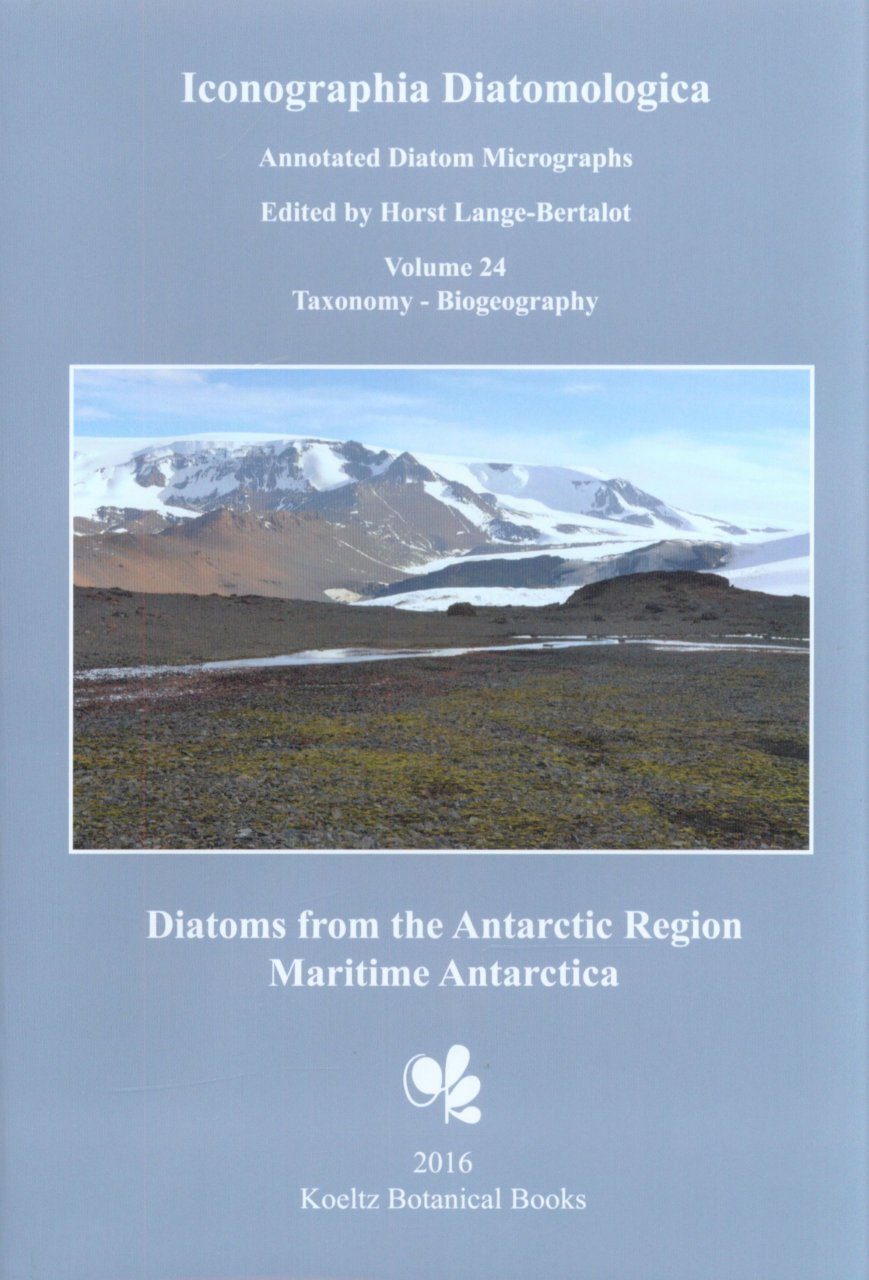 |
| Iconographia Diatomologica, annotated diatom monographs, Volume 24, Diatoms from the Antarctic Region: Maritime Antarctica. 2012. By Ralitsa Zidarova, Katerina Kopalova & Bart Van de Vijver. Edited by Horst Lange-Bertalot. 216 plates and 1 appendix, 504 pages. Koeltz Scientific books. 180€ (prices in other currencies depend on current course). ISBN: 978-3-946583-05-9 |
Review by Anh Tu (Lina) Van *
Antarctica
remains in many ways a scientific frontier – its vast and unforgiving landscape
belies the biological diversity present there.
Within the transient freshwater and wet terrestrial habitats, diatoms
manage to survive. In the last two decades, major strides have been made in
describing the flora and fauna present in Antarctica. This book describes the
nearly decade-long effort
Like the
other Iconographia Diatomologica books, this book is not meant to be read
through. Rather, it is mostly a reference for newly described freshwater and
terrestrial diatom taxa of several Antarctic islands, specifically of the South
Shetland Islands and James Ross Island.
The vast majority of these taxa were established by the authors
themselves.
The book is
well-organized, if a bit unintuitive for perusal, as the taxa are listed
according to the systematic classification of Round et al. (1990), and then
alphabetically within each genus. However, there is an alphabetic taxa listing
to supplement this this. Indices and references are very well crosslinked.
Printing on glossy paper has helped the photographs to be smooth and almost
grain-free.
Species
descriptions are consistent and formulaic, making it easy to search for
specific characters during diagnostic work. Excellent quality LM and SEM photos
accompany the descriptions; scale bars are included on every page. Of most
value might be the comparison with morphologically similar taxa, but the
differences are more clearly described for some taxa than others. There are several well-known and cosmopolitan
taxa described, but interestingly, many of the species seem to be rare or seldom-observed.
Due to sampling methods, there was an unusual and welcome focus on diatoms
found in terrestrial habitats.
There are
only two minor flaws with the book. First, the type localities of novel taxa
are not listed. Rather, the locality descriptions are ecologically-based, e.g.,
“mostly in wet seepage areas with or without moss vegetation cover and on
mosses (p.162)”. While the permanent slides and stubs, and presumably the
metadata, are available at the Botanical Garden Meise (Belgium), an easier
oversight would have been better.
Second, the
book lacks any molecular support for the taxa described. Diatom research is
becoming increasingly reliant on bioinformatics and systematics to resolve
taxonomic problems, one of which is species delimitation. Arguably, the
establishment of new taxa would fall into this category. The introduction has a
brief section on taxonomic revision, so it is surprising to see no mention of a
phylogeny of the individual taxa.
Nevertheless,
it may well be only a minor flaw in the context of the book’s original concept.
Even obtaining environmental DNA metabarcoding data would have been a major
task, possibly beyond the scope of what the authors and their collaborators
were feasibly able to do. And because the book is not posited as a phylogenetic
analysis of diatoms in Antarctica, its main function would be the description
of novel morphological forms of species of diatoms.
This is not
to say that Volume 24 is an insignificant contribution to diatom studies. The
sheer morphological diversity presented here, even for the limited genera
presented, can be seen as a starting point for future biodiversity research. And
although it is not an identification key per
se, its focus on rare taxa, often found in transient habitats, makes it a
valuable work. It will serve as an excellent reference guide for those working
in the Antarctic region.
*Anh Tu (Lina) Van
Universität Rostock
Angewandte Ökologie & Phykologie
Albert-Einstein-Straße 3
18059 Rostock
Germany
Sponsor for this section:

Interested in a book that has not yet been reviewed? Please contact us to review another book and increase your diatom library.


Comments
Post a Comment
Thank you for your comment. Due to an increased number of spam comments, we have felt the need to moderate this section. Your comment will appear in up to 72h. Thank you for your understanding.
Kind regards
Young ISDR